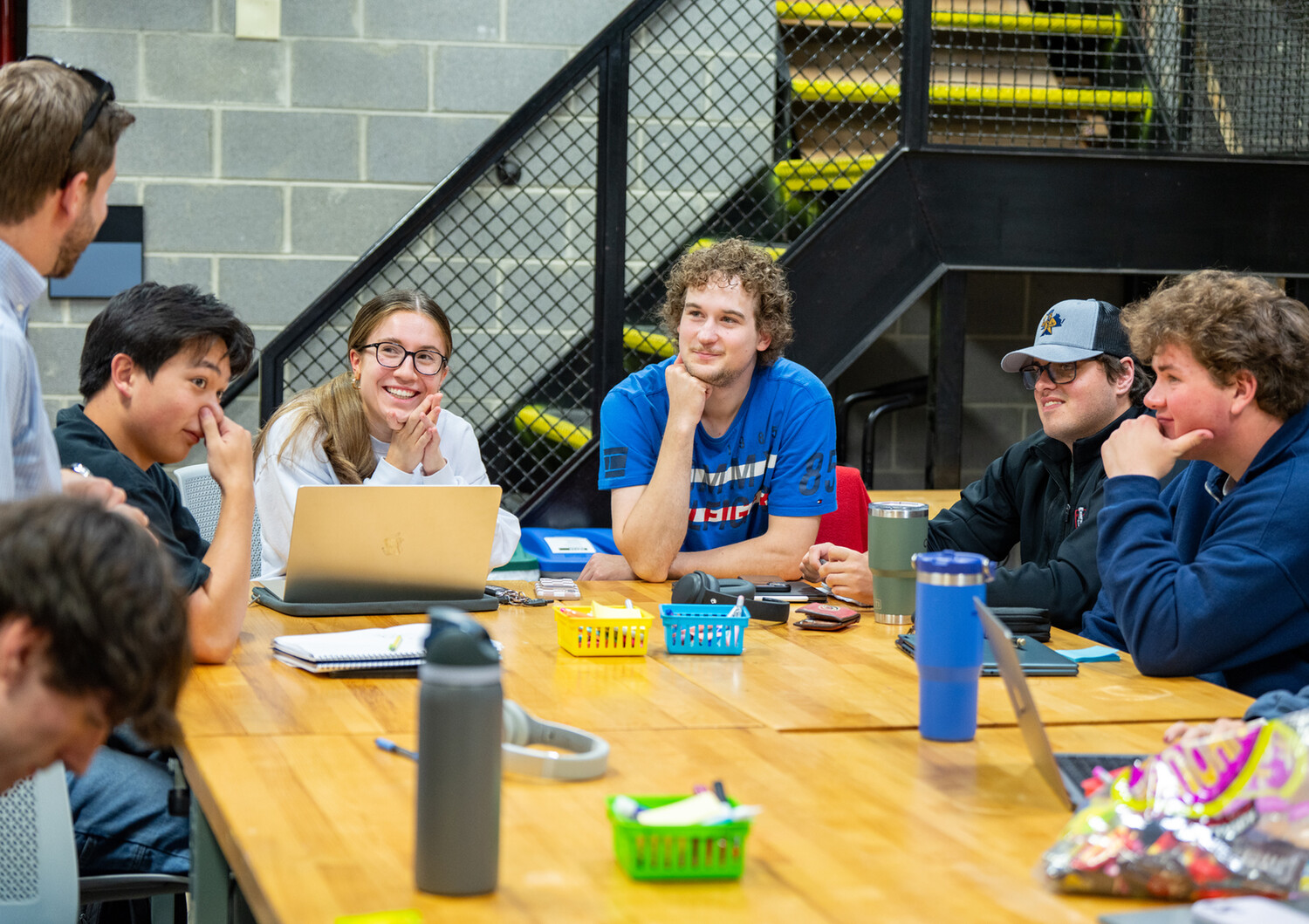

From urban-farming projects to heat sinks to textile waste, students enrolled in the Fall 2025 class AI for Global Impact: Tackling Grand Challenges With Generative AI prototyped solutions to some of the world’s most complex and urgent sustainability challenges.
Two of the instructors, Dr. Raafat Zaini, assistant professor of integrated science and technology, and Dr. Venkat Kolluri, CEO of the internet advertising company Cidewalk, have been friends for more than a decade and have stayed connected through bi-weekly meetings in which they discuss the intersection of industry and academia.
In the spring of 2025, one such discussion led to an intriguing idea. “We realized something important: While AI tools were rapidly advancing and transforming industry, many students — especially non-STEM students — were either ignoring these tools altogether or using them in very limited ways,” Kolluri said. “We recognized a growing AI gap — not just in access, but in meaning, understanding and application.”
This insight led to the development of an X-Labs course that would introduce students to the practical application of artificial intelligence tools and then push them to apply AI to real-world problems.
“We came up with the idea of having something to do with AI, not just at a productivity level, but to take [on] big challenges in the world and use it to collaborate with as a creative partner,” Zaini said. “And I thought, ‘Hey, JMU is very interested in sustainable development goals.’”
Rounding out the class’s teaching team was Dr. Christian Early, director of JMU’s Ethical Reasoning in Action program and professor of philosophy, who brought an expertise in the ethical implications of design thinking and product development.

“So often, what happens is that ethics becomes tacked on at the end,” Early said. “It’s sort of an afterthought. But what we were really working on in this class is incorporating ethics into the thinking for product development and design, so the ethics is less of a catastrophe-event response and more of a navigational guidance tool that you can use in directing your efforts.”
An important aspect of the course’s development was the implementation of the Defense Advanced Research Projects Agency framework, which offered students a template to tackle these large-scale problems. The framework uses the Heilmeier Catechism — named for George H. Heilmeier, former DARPA director — which presents the following questions:
- “What are you trying to do? Articulate your objectives using absolutely no jargon.”
- “How is it done today, and what are the limits of current practice?”
- “What is new in your approach, and why do you think it will be successful?”
By leveraging these questions to help guide decision making, Early found it conducive to how human beings think. “They are helpful not only for product development and design, but also for DARPA to think about which programs to fund and which programs not to fund,” he said.
Many higher-education institutions are still grappling with how to benefit from AI in the classroom and the ethical implications of its usage. But courses like AI for Global Impact tackle that concern head-on.
“One of the most impactful aspects of the course was encouraging students to think of tools like ChatGPT not just as utilities, but as active research collaborators,” Kolluri said.
The course required a shift in mindset, with AI as a collaborator — a skill to learn, not just a shortcut, he said. “Students were guided to use AI for brainstorming, exploring alternative perspectives, refining ideas and iterating on proposals, rather than simply generating final answers.”
Sophomore Finance and Accounting double major Logan McIntire went into the course with some preexisting knowledge on how to harness AI tools, but he hoped for the chance to enhance those skills. That expectation was met during the first class, which included an assignment to use AI to develop a website to help students communicate with AI to produce a product.
“The skill that I developed the most was how to prompt an artificial intelligence system to get a more in-depth understanding of the topic I am researching,” McIntire shared.

He also noticed how challenging it was for him and his classmates to decide on a project focus and design. “Dr. Kolluri emphasized that we need to design our projects in a way that can impact ‘a billion people, not a million,’” McIntire said. “This paved the way for all groups to begin developing their projects on a macro scale.”
With those billion people in mind, McIntire chose to complete his final project individually. He took on the United Nations’ No. 2 sustainable development goal of eliminating global hunger. “The focus of my project was to establish vertical farms that combine natural light with transparent solar panels to grow fresh fruit and vegetables across the world,” he said. Inspiration came from a visit he took to a pineapple farm in Ponta Delgada, Portugal.
Vertical farming is a new and innovative solution to agriculture in the United States, where arable land is decreasing. McIntire, who comes from a family of cattle farmers, has experienced this deficiency firsthand. In this design, crops are stacked on top of each other instead of planted side by side, making it a particularly attractive innovation in urban settings. Vertical farms are typically housed inside a greenhouse-like environment, which allows for year-round food yield and less land and water waste.
“I thought that this vertical farm initiative could be something that can be a reality in the next decade, and, therefore, taking steps toward the establishment of this initiative would be a great experience for me,” McIntire said.

McIntire was proud of how he collaborated with AI tools to bring this project to life.
“I utilized AI to assist me with how my vertical farm concept could grow from an operation based in a large metropolitan area, to smaller communities,” he shared. “Figuring out potential global cities to start in, the costs of establishing a vertical farm, and potential questions a customer may have are examples of my collaboration with AI.”
Kolluri stressed that the goal of the course was to empower students to “think big — to see AI as a force multiplier that enables them to engage meaningfully with global challenges, regardless of their academic background.”
The title, Tackling Grand Challenges With Generative AI, highlights just that. “To me, it reflects a fundamental shift in what this generation of students is capable of achieving. With today’s AI tools, students can now engage with large-scale, complex problems that previous generations — including ours — could not realistically tackle at the same stage.”
Like all other X-labs courses, AI for Global Impact was comprised of students from different majors. “[T]his is one of the messages of this class,” Zaini said. “You don’t have to be a certain kind of person in order to make use of AI and be good at it.” He noted that X-Labs had “all the plumbing to make [the course] happen,” but it was the students who realized their vision for the course — a sentiment shared by Early.
“I think the big achievement was seeing how good JMU students are at collaborating and working together, and noticing how the values of the students were being expressed in the products that they were proposing,” Early said. “None of the schemes were get-rich-quick schemes. They were all thinking about how to make the world a better place … and that just felt really hopeful.”